
The opening DJ has one of the hardest jobs in the room. No one is dancing yet. The lights are still up. You’re playing to staff, early arrivals, and an empty floor that echoes every wrong choice. Yet how you handle the first 90 minutes shapes the entire emotional trajectory of the night.
The mistake most openers make? They think about tracks, not tension. Great opening sets aren’t about individual songs — they’re about the slow, deliberate accumulation of energy. Each track should feel like it belongs exactly where it is, nudging the room forward without ever tipping its hand.
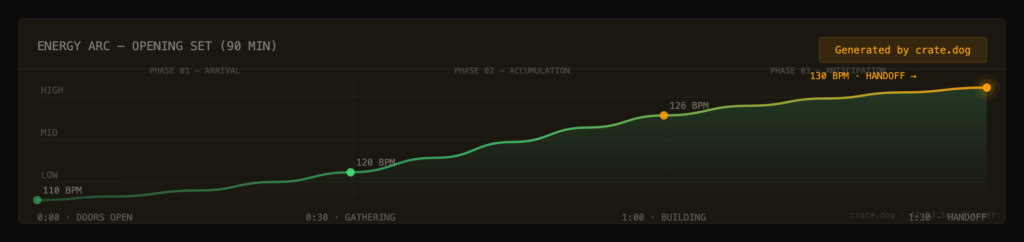
Think of your opening set as three distinct phases: arrival, accumulation, and anticipation. In arrival, the room is still empty — you’re setting a mood, not a dancefloor. In accumulation, early arrivals are starting to feel the space. In anticipation, the crowd knows something is coming and you’re the one stoking that feeling.
Pro Rule
Never play a track in your opening set that you’d want to play in your peak set. Save your weapons. The room will thank you.
Structure
The Three Phases of an Opening Set
Here’s a sample tracklist generated by crate.dog for a 90-minute deep house opening set. The AI builds the arc automatically — pulling tracks by energy profile, key compatibility, and BPM gradient — so every transition is intentional.
Notice how the tracklist moves in steps rather than leaps — BPM climbs 2–3 points at a time, keys shift harmonically, and each phase change feels earned. That’s the invisible architecture of a good opening set. crate.dog generates this structure automatically, giving you a starting point to edit and personalise with your own library.
The AI considers not just BPM and key, but energy density — the number of elements in a track, the intensity of the kick, the weight of the sub — to build a curve you can feel before you hear it.